Your CV Is Brilliant. It Still Won't Get You Hired. Here's What Will.
September 2026 · 20 min read · by Kayode Kolade
What fifteen years on every side of the interview table taught me about the one thing candidates keep getting wrong — and the VALUE™ framework that fixes it.

Maybe you think your CV is brilliant. Two pages of polished achievement, every bullet earned, and you're quietly confident it opens doors.
Or maybe you think your CV is letting you down — too thin, too scattered, not enough shine — and you've half-convinced yourself that's why the offers aren't coming.
Here's the thing I need both of you to hear, because it's the same thing: the CV was never really the point. Not the brilliant one, not the ordinary one. If you've been winning or losing on the strength of the document, you've been playing the wrong game entirely — and once you see the real one, everything gets easier.
I can say this because I have sat in almost every seat around the interview table.
I have been the junior candidate with sweaty palms. I have been the hiring manager choosing between good people. I have been the senior leader who created the need to hire in the first place — who had to justify the role, defend the budget, and decide what value it existed to produce. I have set the standards that recruiters screened against. And for ten of the last fifteen years, I have coached people through the whole thing: professionals at a crossroads, executives navigating transitions, MBA graduates walking into rooms that would decide their next decade.
From all of those seats, one truth keeps repeating itself, and almost nobody walks into an interview knowing it:
Nobody hires you. They hire the value you carry.
Once you understand that — really understand it — everything about how you write your CV, tell your story, and show up in the room changes. So let me give you the whole thing: why value is the hidden currency of every interview, what a CV is actually for, and a framework I have developed over fifteen years on both sides of the table and now use with the people I coach — I call it VALUE™ — that you can use to win any role, at any level, in any field. (Full disclosure: I'm Nigerian and a self-described citizen of the world. I've watched this play out in Lagos boardrooms, East African head offices, and European ones alike — and I promise you, the human dynamics don't change with the postcode. People are people, everywhere.)
Shall we start with two old words?
We have forgotten what these words mean, and forgetting has cost us.
Interview. From the French — inter (between) and voir (to see). An interview is not an interrogation. It is not a trial you survive. It is, quite literally, a seeing between. A shared looking. Two parties trying to see whether there is a fit.
Read that again, because it reorders everything. If an interview is a mutual seeing, then you are not there to be judged. You are there to be seen — and to see in return. The candidate who grasps this stops performing and starts having a conversation. And conversations, not performances, are where offers are made.
Résumé. Also French — it simply means summary. Its formal cousin, the curriculum vitae, means "the course of one's life." Sit with that. Your CV is not a list of jobs. It is the summary of a life's course, compressed onto a page, aimed at a single question: what value does this person carry, and can they bring it to us?
Two old words, two quiet revelations. An interview is a shared seeing. A CV is the story of your value. Hold those, and the rest of this follows naturally.
Why value is the only currency that matters
Let me take you behind the table, to the seat most candidates never see from.
Why does a business — or any organisation — exist? When you strip away the mission statements, it comes to this: an organisation is Product or Service, plus Market or Community, plus People, plus Resources — assembled to produce value.
Often that value is economic. You create it by growing revenue or by reducing cost. (Even a benefit that earns no money directly — a company car, a home, a tool that saves hours — creates value by removing a need.) Value is a bigger idea than money, and this matters, because not every organisation exists to make a profit. A nonprofit, an NGO, a hospital, a school, a foundation, a public agency — these produce value too, just measured in a different currency: a life changed, a need met, a community strengthened, an environment protected, a person given a second chance. I have spent some of my own career in mission-driven and impact organisations, and I can tell you the logic of hiring is identical there. The value isn't cash; it's the impact. However, the question behind every role is exactly the same: what value must this role produce, and who can produce it?
So whether the currency is money or mission, hold onto the principle: organisations exist to produce value, and they hire people to produce it.
And here is the part that matters for you: of all the elements that make an organisation work, people are the one that makes the rest happen. Product doesn't ship itself. Markets don't open themselves. Missions don't advance on their own. Value — economic or human — is produced by people who produce value.
So when a role opens, here is what actually happened behind the scenes, long before you saw the job posting:
- Someone established that a certain kind of value was needed — whether measured in revenue, in cost saved, or in lives changed.
- They justified the need and defended the budget or the funding to pay for it.
- They set requirements — a profile, skills, capability, aptitude, character — that would meet that need.
- Then they went looking for a person who fit, and built a process to validate that the person could deliver.
That process is the interview. The whole thing — the CV screen, the questions, the panel — exists for one purpose: to validate that you will add value that helps them produce value.
This is the reframe that changes everything. Your job in an interview is never to "get the job." It is to make the organisation see the value you will produce. Get that right and the offer takes care of itself. Chase the job instead of the value, and you will interview like everyone else — and lose to the person who understood the assignment.
Your CV is a marketing tool. So you had better be a storyteller.
Here is a sentence I want you to tattoo somewhere useful:
No matter what you do for a living, your real job in a job search is storytelling.
Your CV is not a record. It is a marketing document — the first, most important piece of storytelling you will do. It exists to make a busy, distracted stranger believe you carry value worth a conversation. And like all good marketing, it lives or dies on two things: what you choose to say, and the order you say it in.
Most CVs fail on both.
First, they waste the real estate. A CV is prime, scarce space — and most people fill it with redundancy: every task they ever did, every tool they ever touched, duties that any holder of the title would list. Stop. Every line must earn its place by communicating value. If a line doesn't make the reader think "this person could produce something I need," cut it. Space spent on the unimportant is space stolen from the important.
Second — and this is the one almost nobody knows — they bury the value where no one will scroll to find it.
Here is a principle I have taught for years, learned from the other side of the table: a recruiter or hiring manager decides in the first thirty seconds whether to keep reading. They don't read your CV top to bottom like a novel. They scan. And what they scan first — before they scroll, before they commit — is what I call the primary real estate: the top of the page. Your name, your headline, your first two or three lines.
That primary real estate is your hook. It is the movie trailer, not the movie. And most people squander it on a job title and a home address, then bury their biggest, most valuable achievement three-quarters of the way down page two, where no one who wasn't already sold will ever see it.
Flip it. Lead with your strongest value, stated plainly, in the first lines — before anyone has to scroll. Your profile summary should read like a promise: here is the value I carry, here is the proof, here is where I'm going. Hook them in the first thirty seconds, and they will keep reading. Fail to, and it won't matter how good page two is, because page two never gets read.
A CV, done right, is a story that opens with its most gripping line and never wastes a word. Which is exactly what a master storyteller does.
The story you tell must show direction, not just competence
There is a difference between a CV that lists what you've done and a story that tells someone who you are becoming. The first proves competence. The second proves direction. And here is the quiet truth from the hiring seat: recruiters and hiring managers hire direction.
Why? Because a list of accomplishments tells them what you can do, but a clear direction tells them where you fit — and people who can't be placed don't get hired, no matter how capable they are.
This matters most for anyone with a non-linear path — the person who has worked across sectors, changed fields, taken an unexpected turn. Left as a list, that path looks scattered. Told as a story, the same path becomes intentional. The move is to find the thread: the through-line that connects where you have been to where you're going, so that every past role reads as evidence for your direction rather than a detour from it.
The simplest structure I give people is a three-beat arc — the story you should be able to tell in two minutes, and the story your CV should tell on the page:
- Where I have been — the relevant chapters, briefly.
- The thread that connects them — the value you've been building all along.
- What I am deliberately moving toward — and why this role is the next right step.
Underneath each claim, evidence it. The old discipline still works: STAR — Situation, Task, Action, Result. Not "responsible for improving efficiency" but "here was the situation, here was my task, here is what I actually did, and here is the measurable result." Structure is not decoration. An incoherent story signals incoherent thinking. A clear one signals a clear mind — which is itself a form of value.
The move almost no one makes: interview them back
Remember the etymology. Inter-voir. To see between. A shared looking.
If the interview is a mutual seeing, then you are not only being assessed — you are assessing too. And the candidate who understands this holds a quiet power in the room, because most people forget they have any choice at all.
You should be asking, throughout: Is this a place where my value will actually be valued? Are these people I want to build something with? Does the reality match the pitch?
I say this not as theory but as someone who has been burned. Toxic workplaces rarely look toxic on the way in. They look like opportunity. The dysfunction reveals itself later — after you have invested a year or two, after leaving becomes costly, after your momentum is tangled up in a place that was never right. I have watched good people lose years, and part of their career's clean line, to environments they could have read earlier if they had treated the interview as a two-way seeing instead of a one-way plea.
So do not interview from desperation. Desperation makes you accept what you should refuse and blinds you to the signals that matter. If you tell the story of your value well, you will get a role. The task is not to get any role — it is to walk into the right one with your eyes open. Ask the sharp questions. Read the room. Notice how they treat the people already there. You are choosing too. That quiet confidence — the posture of someone deciding, not begging — is often the very thing that makes them decide on you.
There is a Yoruba proverb I hold onto here: Ẹni máa jẹ oyin inú àpáta, kì í wo ẹnu àáke — the one who will eat honey inside the rock does not mind the blade of the axe. The sweetest honey is the hardest to reach, and whoever is determined to have it does not flinch at what it takes to break through. Go after the roles worth winning with exactly that resolve — strike hard, endure the effort, don't be discouraged by the difficulty. But remember which honey you're breaking rock for. Not all of it is worth the axe. Pursue boldly; just make sure the prize is real.
The VALUE™ framework
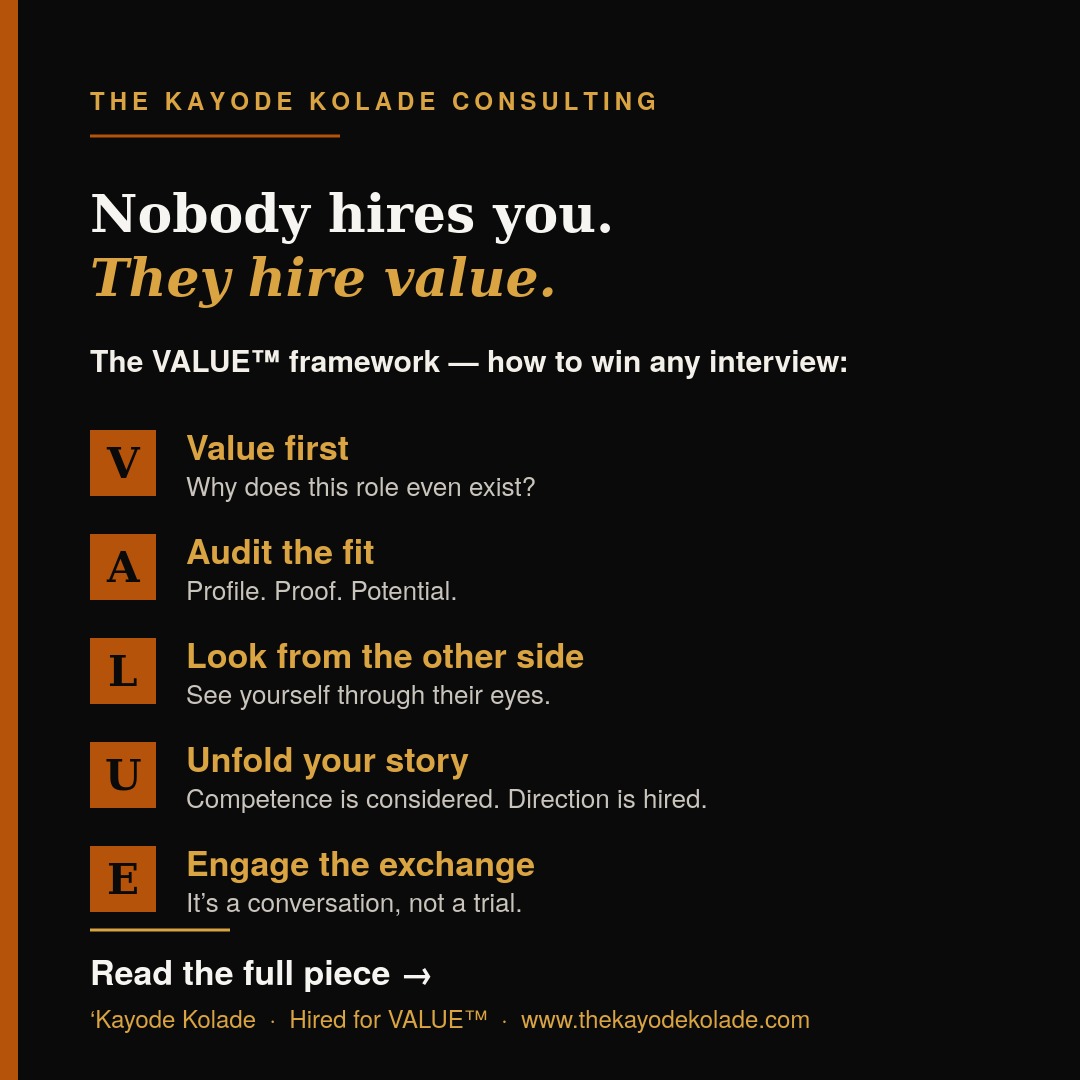
Everything above compresses into five moves — the framework I teach my clients, built from every seat I've sat in at that table. Together they spell the thing every interview is really about. Work them in order, before any interview, for any role, at any level.
V — Value first. Before skills, before stories, ask the question almost no candidate asks: why does this role exist, and what value must it produce? Grow revenue, cut cost, reduce risk, remove a need? Name it — then aim everything you say at it.
A — Audit the fit. Organisations hire against three tests. Do you have the profile (skills, capability, aptitude, character)? Can you prove it (results, evidence, STAR)? And where you fall short, can you show potential (trajectory, learning velocity, a pattern of getting better)? Bring all three. Know which one is carrying the weight for this role.
L — Look from the other side. See yourself through the interviewer's eyes. Know the must-haves and lead with them. Know the red flags and pre-empt them. Make yourself easy to say yes to.
U — Unfold your story. The two-minute arc — where I've been, the thread, what I'm moving toward — evidenced with STAR. Competence gets you considered. Direction gets you hired.
E — Engage the exchange. Inter-voir. It is a shared looking, not a trial. Ask real questions, read the room, assess them as they assess you. Choose. Don't audition.
And now the honest part: it's an art, not only a science
I would be doing you a disservice if I ended there — as though value, told well, guarantees the offer. It doesn't. I have seen people who did everything in this article brilliantly, and still heard "no." So let me tell you the truth from the hiring seat, because understanding it will save you from taking the wrong lesson from a rejection.
Sometimes the best candidate loses — on purpose. I have sat with two genuinely strong finalists. Candidate A was, on paper and in the room, the better hire — more capable, cleaner fit for the role. However, we already had someone on the team who was very like Candidate A, and what the team actually needed was balance. Hiring A would have doubled a strength we already had and left a gap unfilled. So we hired Candidate B — the "lesser" candidate — because they fit the system, not just the seat. Nothing A did wrong lost them that job. The chemistry of a team they couldn't see decided it. Hiring managers are never only hiring for the role; they are hiring for the team, the phase the organisation is in, the balance of personalities and leadership styles, the shape of what they're trying to build right now. Much of that is invisible to you, and none of it is a verdict on your worth.
Sometimes you are simply up against a stronger field. You are not interviewing in a vacuum. You may be one of six excellent people, and five of them may have profiles that fit this particular need better than yours. That is not failure. That is arithmetic. It's also why you bring your best foot forward early and consistently — because the comparison is constant, and you rarely get to see who else is in the room.
And here's a truth the whole system quietly knows: the interview is an imperfect instrument. A short conversation — even ten of them — cannot fully reveal a person's value. I have seen people who interviewed beautifully and turned out to be the wrong call, because ‘articulate’ is not the same as ‘able’. (I have a rule I learned the hard way: the smoothest talker in the process is the one I now double-check the hardest. Charm is a skill. It is not always evidence of any other skill.) And I have passed on people, or almost passed, who went on to become the best hires we ever made — sometimes rescued only by a gut decision to give them a chance. Great interviewing does not always mean great at the job, and the people on the other side of the table know it. They are not just choosing the best performer; they are trying not to make a mistake.
Let me give you three real ones from my own hiring seat, because they show how much of this happens beneath the surface of a "good interview."
Once I had a candidate who was, on paper and in the room, excellent — respectful, articulate, saying all the right things to me. But I made a point of having him meet the people who would actually report to him, and their read was different: they caught glimpses of a concerning attitude the moment he wasn't performing upward. I double-checked, drilled deeper, and eventually let him go from the process. Lesson: how you treat the person who can promote you is not who you are. How you treat the people who can't is. Interviewers who are paying attention will look for both.
Another time, a candidate's profile was genuinely stellar — but something in the CV didn't sit right with me. A small inconsistency, the kind most people skim past. My gut wouldn't let it go, so I kept gently drilling into it across the conversation, and the story kept not adding up. It turned out he had fabricated parts of his history. Reference checks later corroborated exactly what my gut had flagged. Lesson: attention to detail cuts both ways. The same care that makes a CV compelling is the care an experienced interviewer uses to catch what a careless one is hiding.
And a harder one. We were hiring for a country MD role, and some people connected to the panel were quietly trying to push through a candidate they had referred — someone who would owe them, who they could later remind, "we helped you get in." It wasn't about value; it was about leverage. With the talent-acquisition team, I held the line for the person who was genuinely right for the role over the one being manoeuvred in. Had the manoeuvre succeeded, the whole team would have inherited a leader chosen for loyalty rather than capability — a quiet disaster. Lesson, and it's the one that should give you hope: good hiring processes have people in them fighting to keep the process honest. The system is imperfect, yes — but it is not always rigged against merit. Sometimes someone at that table is fighting for it.
Which brings me to the thing I have to add to my own thesis. Yes — organisations hire value, not people. But you are not a value-delivery machine. Some of the most important value you carry is you: your realness, your humanity, whether the person across the table can genuinely connect with you and see themselves working beside you. I have watched an entire decision turn on a single moment of real human connection — one shared thing, one flash of the actual person behind the polish. So do not interview as a flawless mechanism reciting achievements. Let them meet a human. The connection is not separate from the value. Often, it is the value.
The lesson in all of this is not "so why bother." It is the opposite. Do everything in this article — and then hold the outcome lightly. Tell your story well, and you will land somewhere. But when a particular "no" comes, resist the reflex to read it as a verdict on you. It is very often about dynamics you couldn't see, a field you couldn't measure, or an instrument that was never precise to begin with. Every interview you do well takes you a step further, even the ones that don't end in an offer. Hiring is, in the end, as much art as science — human beings reading human beings, imperfectly, under pressure. Your job is to be excellent, be real, be discerning about where you're going — and then let go of the part that was never yours to control.
That is not defeat. That is the clarity that keeps a "no" from touching your confidence — and keeps you walking into the next room whole.
The whole thing, in one breath
Organisations don't hire people — they hire value. So show them the value the role needs (V), prove you carry it (A), through their eyes (L), in a story that reveals your direction (U), in a conversation you are a full partner in (E).
Do that, and you stop chasing jobs. You start making them easy to offer.
Because in the end, an interview was never a test to survive. It was always a seeing between — two parties looking to find out if there is value here worth building on together. Your only job is to make sure they see, clearly, the value you already carry.
There is a Yoruba proverb that says: Wúrà tó máa dán, á la iná kọjá — the gold that would shine must first pass through fire. Every interview, every rejection you didn't deserve, every room that didn't choose you — that is the fire. It is not there to destroy you. It is there to reveal what you're made of, and to burn off everything that isn't the real value you carry. Keep passing through it. Keep telling your story. The gold in you was always going to shine.
Tell that story well. And tell it to the right people.
Kayode Kolade is the founder of The Kayode Kolade Consulting, where he helps professionals, founders, and organisations turn clarity into operating architecture and execution momentum. He is the creator of frameworks including MINED®, UTM™, and the VALUE™ interview framework, a Fellow of the Institute of Leadership & Management, a NeuroLeadership Institute–certified coach, and a member of the International Coaching Federation (ICF). He has spent fifteen years leading operations, setting hiring standards, and coaching people through the interviews that shape their careers.
Clarity is the decision. Architecture is the system that protects it. Momentum is what happens when both exist.
Leave a Comment
Loading comments…